
The bronze doors of the Naval Academy Chapel in Annapolis, Maryland, feature intricate designs that include depictions of significant figures from naval and maritime history, as well as symbolic imagery. These figures are chosen to represent the values, traditions, and heritage of the United States Navy and the Naval Academy. The figure depicted on the Naval Academy Chapel doors holding the tablet and being presented with a torpedo is Moses. This imagery is symbolic and deeply tied to the themes of law, guidance, and divine authority.
Symbolism of Moses
Moses is a prominent biblical figure who is traditionally associated with receiving the Ten Commandments on Mount Sinai. On the Naval Academy Chapel doors, Moses is shown holding a tablet, which represents the moral and ethical laws that guide human behavior. The inclusion of Moses on the chapel doors serves as a reminder of the importance of adhering to moral principles and divine guidance in the service of the nation.
The Torpedo Presentation
The torpedo being presented to Moses symbolizes the intersection of divine law and human innovation. It reflects the idea that even technological advancements, such as weapons of war, must be governed by ethical principles and moral responsibility. This imagery underscores the Naval Academy’s commitment to instilling values of honor, integrity, and accountability in its midshipmen.
Overall Meaning
The depiction of Moses on the chapel doors is a powerful reminder of the spiritual and moral foundation of naval service. It emphasizes the importance of wisdom, ethical decision-making, and the balance between faith and duty in the lives of naval officers.
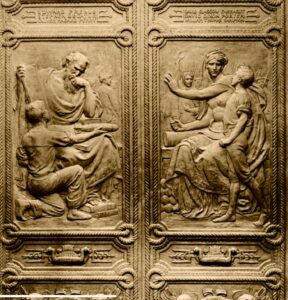
The Chapel Doors also have depictions of several actual historical figures including:
- John Paul Jones
- Known as the “Father of the American Navy,” John Paul Jones was a Revolutionary War naval commander famous for his bold leadership and the iconic declaration, “I have not yet begun to fight!” His inclusion symbolizes courage and the fighting spirit of the Navy.
- David Glasgow Farragut
- Farragut was the first admiral in the U.S. Navy and is best remembered for his command during the Battle of Mobile Bay in the Civil War, where he famously said, “Damn the torpedoes, full speed ahead!” He represents leadership and determination.
- Matthew Fontaine Maury
- Maury was a pioneering oceanographer and naval officer who made significant contributions to maritime navigation and meteorology. His depiction highlights the importance of scientific innovation in naval operations.
- Alfred Thayer Mahan
- Mahan was a naval historian and strategist whose writings on sea power influenced naval policy worldwide. His inclusion reflects the intellectual and strategic foundations of naval warfare.
- Oliver Hazard Perry
- Perry was a hero of the War of 1812, known for his victory at the Battle of Lake Erie and his message, “We have met the enemy and they are ours.” He symbolizes bravery and tactical skill.
Purpose and Meaning
The people and imagery depicted on the Naval Academy Chapel doors serve as a reminder of the legacy of naval service and the qualities expected of midshipmen and officers:
- Courage: Embodied by figures like John Paul Jones and Oliver Hazard Perry.
- Leadership: Represented by David Glasgow Farragut.
- Innovation: Highlighted by Matthew Fontaine Maury.
- Strategic Thinking: Reflected in Alfred Thayer Mahan’s contributions.
These elements inspire reflection on the rich history and enduring values of the Navy and the Naval Academy.
Symbolic Imagery
In addition to these historical figures, the doors feature:
- Angels and Religious Figures: Representing divine guidance and the spiritual foundation of naval service.
- Naval Symbols: Anchors, ships, and waves, emphasizing the maritime mission of the Navy.
Latin Phrases
The Latin phrases inscribed on the doors are significant and often reflect themes of duty, honor, and faith. Some of the notable phrases include:
- “Non sibi sed patriae”
- Translation: “Not for self, but for country.”
- Meaning: This phrase embodies the selfless service and dedication expected of Naval Academy graduates and all members of the Navy.
- “Fortiter in re, suaviter in modo”
- Translation: “Strong in action, gentle in manner.”
- Meaning: This phrase highlights the balance between strength and diplomacy, a key principle for naval officers.
- “Deus et patria”
- Translation: “God and country.”
- Meaning: This phrase reflects the dual commitment to faith and national service.
- “Ad gloriam Dei”
- Translation: “To the glory of God.”
- Meaning: This phrase emphasizes the spiritual purpose of the chapel and the importance of faith in guiding naval service.